
13 Ways to Make Your Business Special
Finding Your USP
Capitalize on the fact that you're different, make that your thing. Think of how Chick-fil-a is known for their friendly service, how Yeti is super durable, or how Goodwill promotes their charity work. These are their USP's, the reason for someone to purchase from them instead of a competitor.
This can be a challenge for some businesses, but there is always something that makes you different from everyone else. And if you feel you're too basic -- make something different!
Once you find your USP, put it on center stage. Use it to introduce yourself to new customers and position yourself against competitors.
Below are some USP ideas to get your wheels turning. Imagine how these fit into your company goals and values, your founding principles, and your mission statement.
But look at this from an analytic viewpoint as well. What kind of feedback or reviews do you get from customers, employees, even family and friends? When you mention your brand, what do people most immediately associate it with? You can take that gut feeling people have when they think of your brand and make that your USP.
Try considering some of these USP ideas.
P.S. - Unique Selling Point (USP) is also known as Unique Value Proposition/Position (UVP).
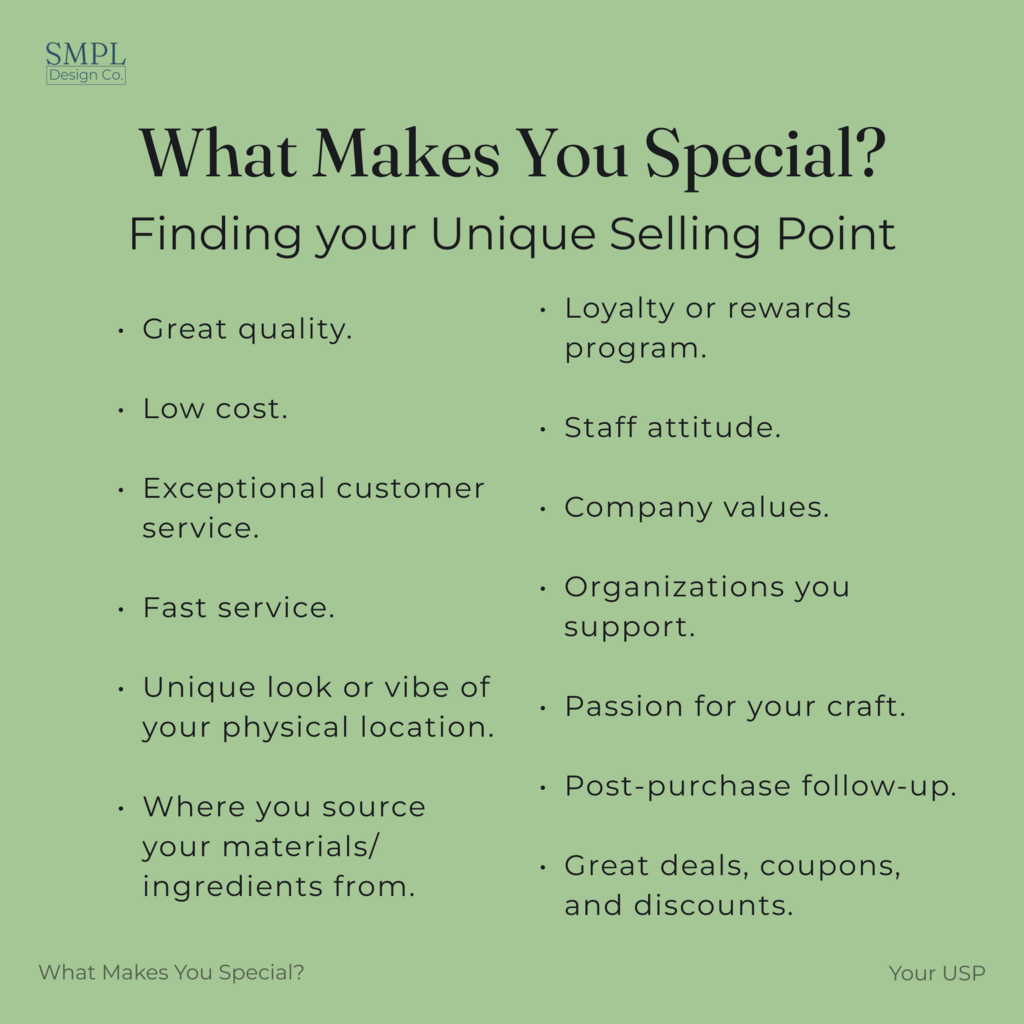
Click "Download this Image", right click, and select "Save Image As. . ." to download.
1. Great Quality: Your product is worth the price because it’s just better. The ingredients, the materials, the presentation, the whole shebang is just such good quality, people can’t pass up on it. This may work best for physical products over service or food industries.
2. Low Cost: Be careful with this one, because people often associate low cost with low quality. This is good for an industry where low cost and high quality can work together. This may be good for service-based fields, like plumbing, where the service either fixes the problem or doesn’t, and your low prices don’t scare your clients.
3. Exceptional Customer Service: Do you have a super quick 24/hour chatline? Do managers exclusively handle customer complaints? Are you quick to offer returns, refunds, guarantees, or replacements? For some products, customer service doesn’t matter much. If it’s too much work to return certain products, most customers will keep them and use them to some capacity. But for things like Software-as-a-Service or technology-based products in general, it can be so freeing to know that help will be there if things go wrong (because they will go wrong, they always do).
4. Fast Service: Time is a factor for some industries. For example, Take 5 advertises 10 minute stay-in-the-car oil changes for their customers. For someone who doesn’t want to go carless, time could factor into where they get their next oil change.
5. Unique Look or Vibe of your Physical Location: Do you have cool, themed art? This can be as extreme as a T-Rex Cafe, Rainforest Cafe, or Hard Rock Cafe (lots of cafes), or as subtle as your plant wall, your art exclusively from local artists, or your board game collection available to customers. I know of a cheese shop who uses their price labels with illustrations drawn by employees as a sort of USP. Much of their website and social media draws on these quirky illustrations, making them recognizable to locals.
6. Where you Source your Materials/Ingredients From: This is popular for anyone in the coffee industry, but it works just as well for someone outside of it. Maybe you source 5/10 of your products locally. Your competitors might too, but if you say “We source half of our products from local farmers/manufacturers/artisans/companies”, people are going to wonder how much your competitors source locally. They’re probably going to assume it’s less than you, since your competitors don’t mention it.
7. Loyalty or Rewards Program: This is HUGE, and keeps customers coming back time and time again, if done well. Let customers log on to an app, hand over a punch card, or provide a plastic VIP card to be scanned at checkout. Personally, I almost exclusively shop or eat places where I am a rewards member. If I’m going to get it either way, I might as well earn a little kickback from it! This works great if you’re in a field where yours and your competitions cost, quality, and customer service are all on a fairly equal playing field.
8. Staff Attitude: Your staff should always put on a kind attitude on the clock, obviously, but having exceptionally cheerful faces around could be a deciding factor for some people. Think Chick-fil-a. In the oversaturated industry of fast food, they manage to stand out because their employees are trained to be friendly, to the point of meme-ification.
Or, on the reverse, think of restaurants like Dick’s Last Resort or Karen’s Diner, where the employees are exceptionally unprofessional to their customers. Their food might not be fantastic, but the fun(?), interesting, and unique experience to be yelled at by your server is worth it for people to visit.
9. Company Values: What does your company really stand for? Why were you established? What is your mission statement? How can the average person relate to it? Rather than just telling me your values of “Good Quality and Commitment to the Customer”, show me. Show how you live your values and why anyone should care.
For example, SMPL Design Co. values align with the idea that we want to give our clients the power. Many design or marketing agencies want to be in complete control, but we want to give our customers the ability to manage their business without relying on us. We want to give the tools and the knowledge for our clients to fire us, if they want. Our company values are our USP, because we don’t want to be held on retainer, not unless you want to give us that position in your company. We offer different levels of involvement to potential customers so they can choose how much control we have over their company.
10. Organizations you Support: More than any other idea here, this can potentially have the ability to alienate parts of your audience. Some organizations are controversial for whatever political, religious, or emotional reasons. Don’t be afraid of this, but be careful not to come off as “better than”, if that’s not the position you want to take.
11. Passion for your Craft: Before I started working with a client of mine, my boyfriend and I visited their pizza joint. And then we went again, and again, and again. Then, my now-husband got a job there. Yes, the pizza is amazing, the customer service was good, and the prices were decent, but none of those stood out nearly as much as the pure passion of the owner and general manager. These (two separate) individuals absolutely love the restaurant. They talk to every customer possible, while still delivering delicious food. They gush about their high-quality ingredients. They give recommendations, sometimes even offering free samples to skeptical diners. They really care about and love the place they work and what they do there, and that makes us loyal customers. If you’d go above and beyond for your business; if you couldn’t imagine doing anything different; if you’d do it for free, if you really had to: tell your customers that!
12. Post-Purchase Follow-Up: Not just a “Hey {First Name}, hope you liked your product. Give us a review!” email, but real follow-up. Offer check-ups within a certain timeframe, related products, tutorials, or new updates to their current product. This can work for any industry, and to some extent should be applied by every company. Proper follow-up can turn a content customer into a returning customer.
13. Great Deals, Coupons, and Discounts: Places like Price Chopper or Hobby Lobby implement this a ton. I only shop in those places when they have great deals, and I always end up getting things I didn’t intend to get. You could also offer themed discounts like “Military Monday” or “Senior Saturday” for consistency. If offering lots of deals is something that appeals to you and works for your company, you can work this into your USP.


