
How to Be Fake on Social Media
Well . . . Kinda
Here’s the thing: social media isn’t real life. We know that it’s a glorified version of everybody’s life. Most people encourage content creators and brands to be 100% authentically you on social media, and I think this does work for some people. But for people like me, who are maximalists, chaotic, introverted, and sarcastic with a dry sense of humor that most people don’t enjoy, being 100% me just doesn’t make sense. It doesn't fit the audience I want to reach and it doesn’t fit my business goals.
So I should be fake, right?
I should become someone more fit for the camera?
Sort of, but not really.
Social media, for me, is part of my business. The person I am around my family and friends is different from the person I am at work, that’s the way it’s always been for me, and for a lot of people. I treat social media the same way.
There’s no need for me to bring out sarcasm when I’m working a customer service job, because the customer doesn’t know me and will assume it’s disrespect, not a joke. If I’m unorganized at work and say it’s my “maximalism”, my boss probably won’t appreciate it. If it takes me far too long to complete a task that I get paid to do, I’m going to be replaced by someone more efficient. Social media is the same way, except I’m my own boss and I need to keep myself accountable.
The way I see it is that I don’t have the right to relax and slip into my “family and friends” self when I’m at work.
I started figuring this out pretty quickly, when it would take me an entire day to make one Instagram post. I love tiny details in design, and I wanted to make posts that would appeal to me. But I’m not my target audience. My target audience is small business owners who DON’T love design or marketing. After a few posts, I started attracting other designers on my Instagram.
At first, it felt nice to have followers and likes. But what’s the point of having followers and likes when all of those people offer the same services as me?
I realized I would never be able to expand my network, I’d be stuck in an echo chamber of marketers and designers just like me. Which is great for building community, don’t get me wrong, but not so great at making money.
So I adjusted my social media personality to fit my goals.
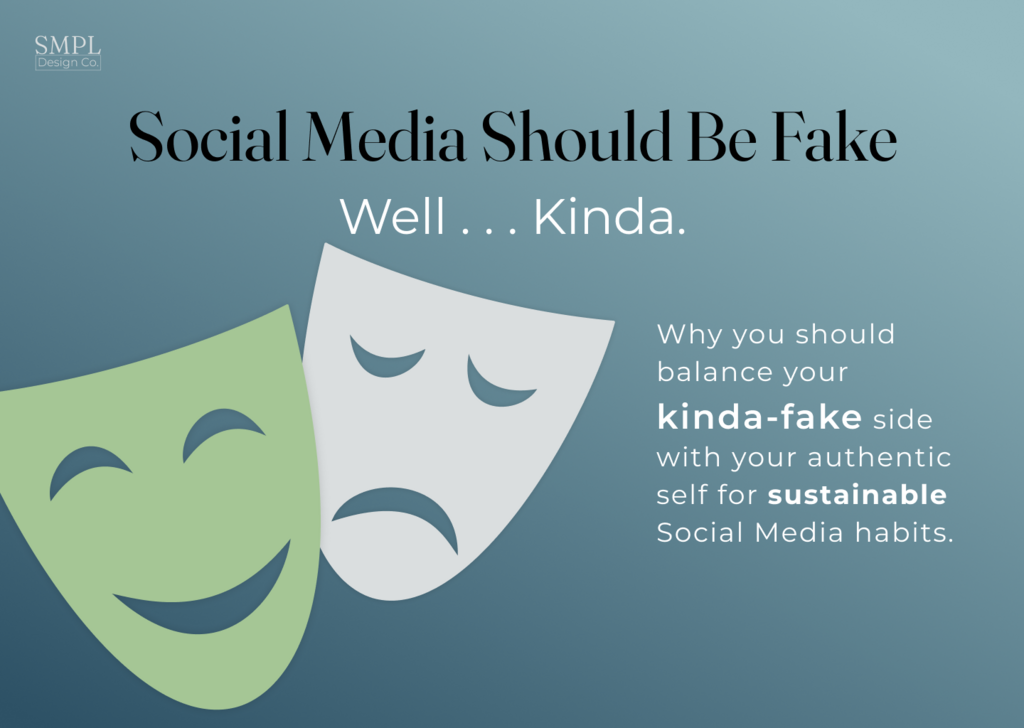
Instead of being the maximalist I am, I forced (still do force, actually) myself to cut down all the information to the bare minimum. I took out all pretty graphics, all fun gradients, and made my social media posts fit the audience it’s supposed to fit; people who value their time, want answers quickly, and don’t like B.S.
There’s a part of me that loves minimal, clean designs, organization, and getting straight to the point without fluff. That’s my Social Media Me.
There’s another part of me that adores fluff and that craves over-explaining everything. That’s my Blog Me, if you can’t tell.
Neither one of these “Me’s” are fake, but neither are 100% authentic. People are complicated, we have layers, and for a lot of people, it’s not sustainable/reasonable to be 100% themselves off and online.
That’s why social media should be kinda fake. Take a part of you that fits the industry, brand, and goals of your social media account, and bring that to the spotlight. Don’t suppress everything else, don’t be afraid to show other parts of yourself, but remember that you have a duty to your business to act with a certain amount of professionalism. This professionalism isn’t being fake, it’s just being respectful of others time and money.
So don’t stress when you’re kinda fake on social media. If that’s what works for you, then that’s what works for you!


